

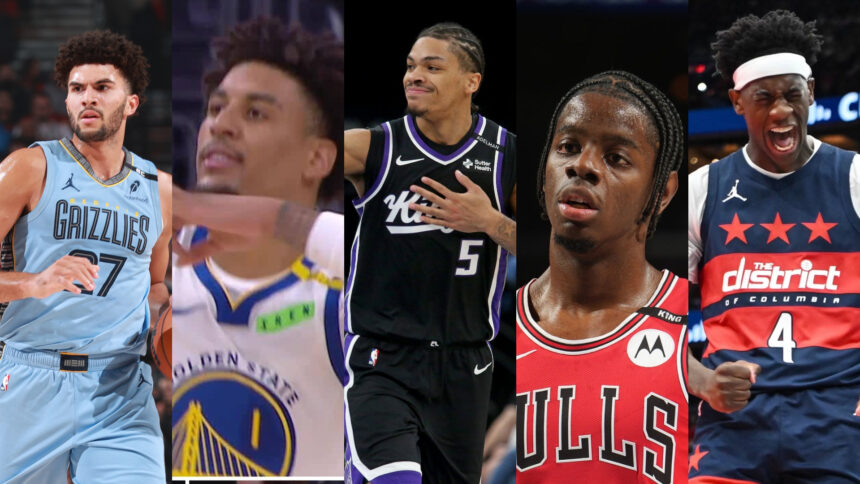
The NBA’s 2026 rookie class is wasting little time announcing its presence. Barely two weeks into the new season, several first-round picks have already begun putting up numbers that would attract attention, even from established league star players. By Daniel Similoluwa Adebanji
From Cameron Boozer’s all round brilliance in Memphis to Yaxel Lendeborg’s amazing start with Golden State and Darius Acuff Jr’s explosive scoring in Sacramento. These early performances have offered plenty of reasons to be excited.
But then, excitement and long-term greatness are two different things.
Jeff Zillgitt’s latest Kia Rookie Ladder on NBA.com, provides an interesting picture of a class that appears determine to make immediate impact. Boozer currently leads the rankings, followed by Yaxel and Acruff, while Caleb Wilson and AJ Dybantsa complete the top five.
The question is, are these performances enough to begin to identify the next generation of NBA franchise players.
A rookie Class making immediate statement
There is no denying the quality in these performances, and that these rookies are here to here to stay.
Boozer, selected third overall by Memphis is averaging 17.4 points, 10.3 rebounds and 5.6 assists per game. Averaging a double double as a rookie has been the most impressive so far. His versatility has made him one of the most intriguing players in the class.
🏀 THURSDAY’S FINAL SCORES 🏀
Cameron Boozer (19 years, 103 days) becomes the second-youngest player ever to record a triple-double to lead the @memgrizz to their first 5-0 start since 2014-15!
Isaiah Stewart: 18 PTS (7-10 FGM), 3 REB
Cedric Coward: 17 PTS, 7 REB, 4 AST, 3 STL, 3 3PM— NBA (@NBA) October 30, 2026
Yaxel Lendeborg’s emergence has been equally shocking. The 11th overall pick is averaging 21.5 points, 7 rebounds and 3.9 assists. His performance has been a revelation for Golden State and their fans, considering his position on the draft.
YAXEL LENDEBORG: MOST POINTS BY A WARRIORS ROOKIE IN A SINGLE GAME SINCE STEPH IN 2010!
🌉 37 PTS (career-high, game-high)
🌉 6 AST
🌉 6 3PM
🌉 13-19 FGM4 straight wins for @Yaxel_Lendeborg and the @warriors! https://t.co/422cb82ur7
— NBA (@NBA) November 2, 2026
The most eye-catching of them is Acuff’s explosive scoring. The Sacramento Kings guard is averaging 26.1 points and 6.3 assists, demonstrating an ability to lead an offense and take charge early in his NBA career.
Darius Acuff Jr. in last night’s action:
38 PTS (game-high)
9 3PM (ties NBA rookie record)Acuff Jr. (19y, 349d) became the youngest player in Kings franchise history to record consecutive 30-PT games… surpassing Oscar Robertson (21y, 357d)!
https://t.co/aY5KWWCbR3— NBA (@NBA) November 1, 2026
Then there is Wilson, who is becoming an intriguing two-way prospect. Average 21.6 points, 6.7 rebounds and two steals, he has shown he can impact the game on both ends.
Swat, runs the break… and throws the lob!
Caleb Wilson making plays on BOTH ends for the @chicagobulls 👏 https://t.co/rvfydMfzdO
— NBA (@NBA) October 29, 2026
Dybanta, the first overall pick, has made an encouraging start following his return from an ankle injury. He averaged 19 points across his first three games.
AJ Dybantsa’s NBA journey is officially underway!
In his @WashWizards debut:
🧙♂️ 19 PTS
🧙♂️ 8-12 FGM https://t.co/5lSPqFutTy— NBA (@NBA) October 29, 2026
All of these performances tell a story, that several members of the class can control immediately rather than spend their first NBA season settling in.
But does these production translate into franchise-player potential?
Who is a franchise player?
A franchise player is someone who isn’t just the highest-scoring player on a team or the most exciting in the league. It is someone a team can confidently build around for years, particularly when competing for championships.
And that requires more than putting up impressive numbers during the opening weeks of a season.
For Boozer, the encouraging signs are his versatility, his ability to influence different sides of the game, e.g. his rebounding, and playmaking. However, he will need to demonstrate that he can consistently become a primary offensive option against the league’s best defense.
Lendeborg presents a different case. His shooting efficiency, contribution defensively is very impressive, overall production, outstanding, considering his draft position. The bigger question is whether he can maintain that level of offensive responsibility enough to give the greatest three-point shooter of all time, Stephen Curry an early retirement.
Acuff’s scoring ability is difficult to ignore. However, his current shooting percentages (40.6% FG) indicate that there is still room for development. His ability to make effective decisions under pressure will also be important in determining his long-term ceiling.
Wilson’s two-way game offers Chicago plenty to work with, while Dybanta’s scoring instincts and physical tools make him one to look out for. Comparing him to Shai-Gilgeous Alexander won’t be outrageous.
The fans’ Verdict: Who would you build around?
The debate around the 2026 rookie class is not limited to NBA analyst. Basketball fans have been attempting to identify which prospects could eventually become the faces of their respective franchises.
In a discussion with members of a basketball group, several names emerged as potential franchise players.
Caleb Wilson, Darius Acuff Jr, and Yaxel Lendeborg featured prominently, with AJ Dybantsa receiving little to no mention. another member of the group offered a shorter shortlist, identifying Lendeborg, Acuff, Wilson and Darryl Peterson of Utah Jazz as players with franchise-player potential.
Surprisingly, Lendeborg’s name came with a condition. He suggested that if he could sustain a scoring average of around 20-23 points per game over the next three seasons, he could establish himself as the next franchise player for Golden State. Otherwise, he would be a valuable second option on a competitive team.
Boozer’s assessment was more cautious. Despite his remarkable all-round production, one of the contributor felt he had yet to demonstrate the qualities of a franchise player, though he acknowledged that he remained a prospect.
Peterson also had some uncertainty from the contributors. One pointed to his inability to establish himself ahead of Keyonte George in Utah as a reason for withholding judgement on his franchise-player potential.
This discussion reveals an interesting fact. Some fans already identified players they believe could become franchise cornerstones, others are more cautious about separating early production from long term potential.
For now, the 2026 class deserves its recognition. Whether any of its members will eventually become the face of a franchise, is a question that only time can answer. Yankee Scores reports