

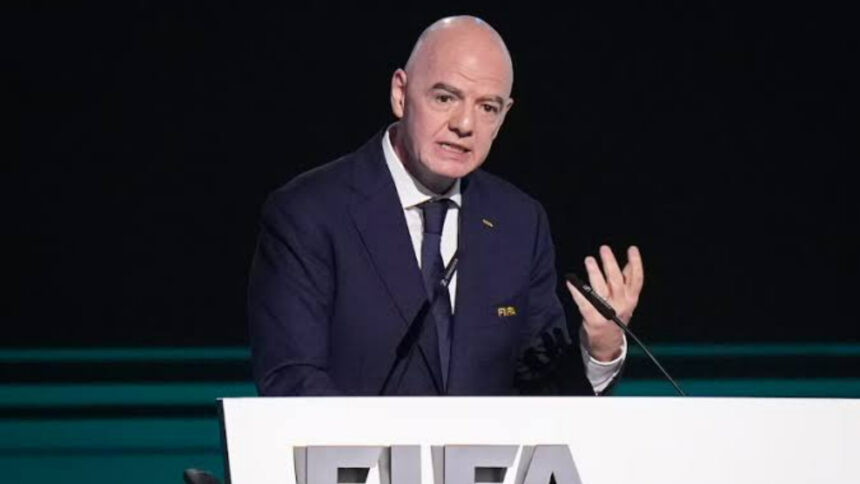
Amid scathing criticisms, FIFA president Gianni Infantino has justified the introduction of hydration breaks at the ongoing World Cup, Yankee Sports reports.
England boss Thomas Tuchel added his voice to the litany of criticisms before the goalless stalemate against the Black Stars of Ghana, claiming “it interrupts and changes the identity of a football match.”
Likewise, Uruguay coach Marcelo Bielsa expressed his frustration after his side drew Cape Verde 2-2. Bielsa said it “adds nothing and takes away a lot.”
However, the world football governing body boss insisted that the heat in the United States was mainly responsible for the introduction of the cooling breaks.
Player Welfare Defense
“The main reason is the heat, but we also have to understand that in a competition like the (FIFA) World Cup, played over 39 days, with teams potentially playing eight matches in those 39 days, having a moment to rest is extremely important.
Infantino claimed that the practice of hydration breaks in air-conditioned stadium is geared at giving coaches equal opportunity.
“What matters even more to us is ensuring that all teams, in every match, are playing under the same conditions. And it’s very difficult to accept that a coach might have the opportunity to influence a match by making adjustments simply because it’s hotter, while in another match, where the temperature is slightly lower, the same coach doesn’t have the same opportunity. We want to ensure equal conditions for everyone, and that’s why these breaks are implemented in every match.”
Infantino insisted that the cooling breaks add nothing to FIFA revenue
“absolutely nothing” from the breaks. “There is no additional revenue for FIFA, as all commercial agreements were signed well in advance. So, this is not a financial issue for us. For us, it is purely a sporting matter.”
For the first time at a FIFA World Cup, hydration breaks have been introduced at all matches. The breaks are observed in the 22nd and 67th minutes and last three minutes, which are added on to the stoppage time at the end of each half, according to FIFA.